
Other Google Search Events
Every ranking update and Search incident Google has confirmed on its own Search Status Dashboard, with the exact start and end timestamps Google published and the rollout duration calculated from them. Google reports when an update began and when it finished, but never how long it took — that column is computed here.
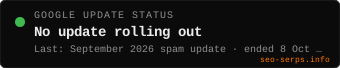
Is Google rolling out an update right now?
No. Google has no confirmed ranking update in progress.
The most recent was the September 2026 spam update, which finished on 8 October 2026 — 8 days ago — after a rollout of 13 days, 15h.
Was Google updating on a given day?
Enter the date of a traffic change and see which confirmed updates were rolling out at the time.
2026
| Update | Type | Started | Finished | Rollout | Affected |
|---|---|---|---|---|---|
| Serving was experiencing an issue | Serving | 03:55 UTC | 04:10 UTC | 15 min | Serving |
| February 2026 Discover update source ↗ | Discover update | 17:00 UTC | 10:00 UTC | 21 days, 17h | Ranking |
2025
| Update | Type | Started | Finished | Rollout | Affected |
|---|---|---|---|---|---|
| Serving is experiencing an ongoing issue | Serving | 20:00 UTC | 20:40 UTC | 3 days | Serving |
2023
| Update | Type | Started | Finished | Rollout | Affected |
|---|---|---|---|---|---|
| November 2023 reviews update Google said this would be the last separately announced reviews update. | Reviews update | not recorded | not recorded | Ranking | |
| September 2023 helpful content update | Helpful content | not recorded | not recorded | Ranking | |
| April 2023 reviews update | Reviews update | not recorded | not recorded | Ranking |
2022
| Update | Type | Started | Finished | Rollout | Affected |
|---|---|---|---|---|---|
| December 2022 helpful content update | Helpful content | not recorded | not recorded | Ranking | |
| Helpful content update First site-wide signal aimed at content written for engines rather than people. | Helpful content | not recorded | not recorded | Ranking |
2021
| Update | Type | Started | Finished | Rollout | Affected |
|---|---|---|---|---|---|
| Page experience update Core Web Vitals folded into ranking. Rolled out gradually to the end of August. | Ranking signal | not recorded | not recorded | Ranking | |
| Product reviews update The first of the product review series. | Reviews update | not recorded | not recorded | Ranking | |
| Passage ranking | Ranking update | not recorded | not recorded | Ranking |
2019
| Update | Type | Started | Finished | Rollout | Affected |
|---|---|---|---|---|---|
| Site diversity update Limited repeated results from one domain. | Ranking update | not recorded | not recorded | Ranking |
2018
| Update | Type | Started | Finished | Rollout | Affected |
|---|---|---|---|---|---|
| Speed update Page speed became a mobile ranking factor. | Ranking signal | not recorded | not recorded | Ranking | |
| Mobile-first indexing rollout | Indexing change | not recorded | not recorded | Ranking |
2017
| Update | Type | Started | Finished | Rollout | Affected |
|---|---|---|---|---|---|
| Intrusive interstitials penalty Demoted pages where mobile content was obscured by pop-ups. | Ranking signal | not recorded | not recorded | Ranking |
2016
| Update | Type | Started | Finished | Rollout | Affected |
|---|---|---|---|---|---|
| Possum nickname | Local update | month only | not recorded | not recorded | Ranking |
2015
| Update | Type | Started | Finished | Rollout | Affected |
|---|---|---|---|---|---|
| Mobile-friendly update ("Mobilegeddon") Mobile friendliness became a ranking signal on mobile. | Ranking signal | not recorded | not recorded | Ranking |
2014
| Update | Type | Started | Finished | Rollout | Affected |
|---|---|---|---|---|---|
| HTTPS as a ranking signal source ↗ | Ranking signal | not recorded | not recorded | Ranking | |
| Pigeon nickname Substantial rework of local results. | Local update | not recorded | not recorded | Ranking |
2012
| Update | Type | Started | Finished | Rollout | Affected |
|---|---|---|---|---|---|
| Venice nickname Localised ordinary results by the searcher's location. | Local update | month only | not recorded | not recorded | Ranking |
Take this with you
Drop the update windows straight into a client deck, a Looker Studio annotation layer or your own dashboard — rather than rebuilding the table by hand.
Show the live status on your own site
A small badge that always shows whether a Google update is rolling out. It updates itself; paste it once.
Understanding Google updates
The three kinds, and why the difference matters
Core updates
Broad changes to how Google's ranking systems assess content overall. They are not penalties. Google's own position is that there is nothing specific to fix — a site can drop without having done anything against the rules, simply because the systems now weigh things differently.
Rankings move in both directions, and a drop is often a competitor rising rather than you falling.
Spam updates
These are about violations — link schemes, scaled content abuse, site reputation abuse. If a spam update hits you, something on the site is likely breaching a stated policy, and the fix is to identify and remove it.
The practical difference from a core update: here there usually is something specific to find.
Incidents
Bugs rather than intentional changes — indexing failures, serving faults, ranking systems misbehaving. Google fixes them and rankings usually return by themselves.
Worth recognising, because acting on a temporary bug is how people break working sites.
Algorithmic versus manual
Everything on this page is algorithmic. A manual action is different: a human reviewer at Google penalised your site, and it appears in Search Console under Security & Manual Actions with a reconsideration process.
If Search Console shows nothing there, no amount of reading this page will change that — you are looking at an algorithmic movement, and there is no appeal, only improvement.
What to do when one lands
- Confirm it is actually Google. Use the date lookup above. If nothing was rolling out, look at your own deploys, robots directives, server errors and migrations first.
- Wait for the rollout to finish. This is the single most common mistake. Rankings swing hard mid-rollout and settle afterwards. Core updates in this archive have averaged 22.0 days, spam updates 10.3 days. Changes made on day three get judged against data that no longer applies by day twelve.
- Compare clean windows. Measure the period before the start date against the period after the end date — not against the middle.
- Segment before concluding. A sitewide average hides almost everything useful. Split by page type, query intent and landing page. Most "sitewide drops" turn out to be one template or one query class.
- For a core update, improve rather than hunt. Google publishes questions to assess content quality against; they are a better use of a week than searching for a technical smoking gun that is not there.
- Expect recovery to take a while. Meaningful movement after a core update generally arrives with a later core update, not days after a fix.
How to read the table above
- Rollout is computed here from Google's published start and end times. Google does not publish the elapsed figure anywhere.
- Affected shows which Search system Google flagged — Ranking, Indexing or Serving. An indexing incident and a ranking update call for completely different responses.
- “Not recorded” means Google never published a completion date, which is normal for anything before the Search Status Dashboard existed. It does not mean still running.
- “Nickname” marks names the industry invented. Medic, Fred, Mobilegeddon and Phantom were never Google's terms — useful to know before quoting one to a client.
New to this? The site guide covers filtering, search operators and how to track a specific client or vertical.
About this record
Every row comes from Google's Search Status Dashboard, which is where Google confirms the start and end of ranking updates. Times are as Google published them, in UTC. The Rollout column is calculated from those two timestamps — Google does not publish it.
This table has two sources, and they are not equally precise. Rows from roughly mid-2025 onward come from Google's status API and carry exact timestamps to the minute. Earlier rows are compiled from the public record, because Google's API only ever exposes its ten most recent incidents — everything older had to be assembled by hand.
Compiled rows show the announced start date and no clock time. Where only the month is reliably established the cell says month only rather than inventing a day. Rollout end dates are mostly absent because Google did not publish them before the status dashboard existed; those read not recorded, never “ongoing”, which would be plainly false for a 2014 update.
Names marked nickname were coined by the industry, not by Google — Medic, Fred, Mobilegeddon and Phantom were never official. Most update histories print them alongside Google's own names with nothing to distinguish the two.
Spotted an error? Corrections are genuinely welcome at contact [at] seo-serps.info.
74 events on record · checked against Google's status API every 15 minutes